ScientistTwo: Pioneering the Human Knowledge Frontier with Autonomous AI

Jaehyun Nam Jinsung Yoon Yanzhou Pan Yubo Wang Rui Meng Parthasarathy Ranganathan Tomas Pfister
Google Cloud AI Research
86 / 107
Papers Beating Human SOTA
+25.2%
Avg. Relative Gain
7.5/10
ScholarPeer
5.7/10
Stanford Agentic Reviewer
Avg. Review Rating
Above the averages of accepted ICLR 2026 and NeurIPS 2025 papers under both reviewers.
4 / 4
Integrity Audits Passed
Scores reproduce · no spec violations · 0 of 1,814 references hallucinated · method matches code.

What the integrity audit checks. Every paper is re-examined against its own artifacts: the released code is re-run to confirm each reported number, the solution is checked for specification violations and reward hacking, every citation is verified to exist, and the written method is matched line-by-line against the implementation. ScientistTwo's papers are not only rated at expert level—their results are fully verified and reproducible.

See It Run

Coverage

Domain Coverage

The generated papers span eight AI domains, each broken down into the sub-domain the paper addresses and the method it introduces. Click a domain to jump to its papers in the gallery above.

Expanding the Frontier

Autonomous Research Beyond Human SOTA

ScientistTwo autonomously pushes the frontier of human knowledge across ten-plus research domains—LLMs, robotics, neuroscience, speech, robustness, reinforcement learning, game theory, privacy, optimization, and time series—producing publication-quality papers together with fully verified codebases. Across 107 research problems drawn from recent top-tier publications, ScientistTwo improves on the human state-of-the-art in 86 of them (an 80.4% success rate), with an average relative improvement of 25.2%.
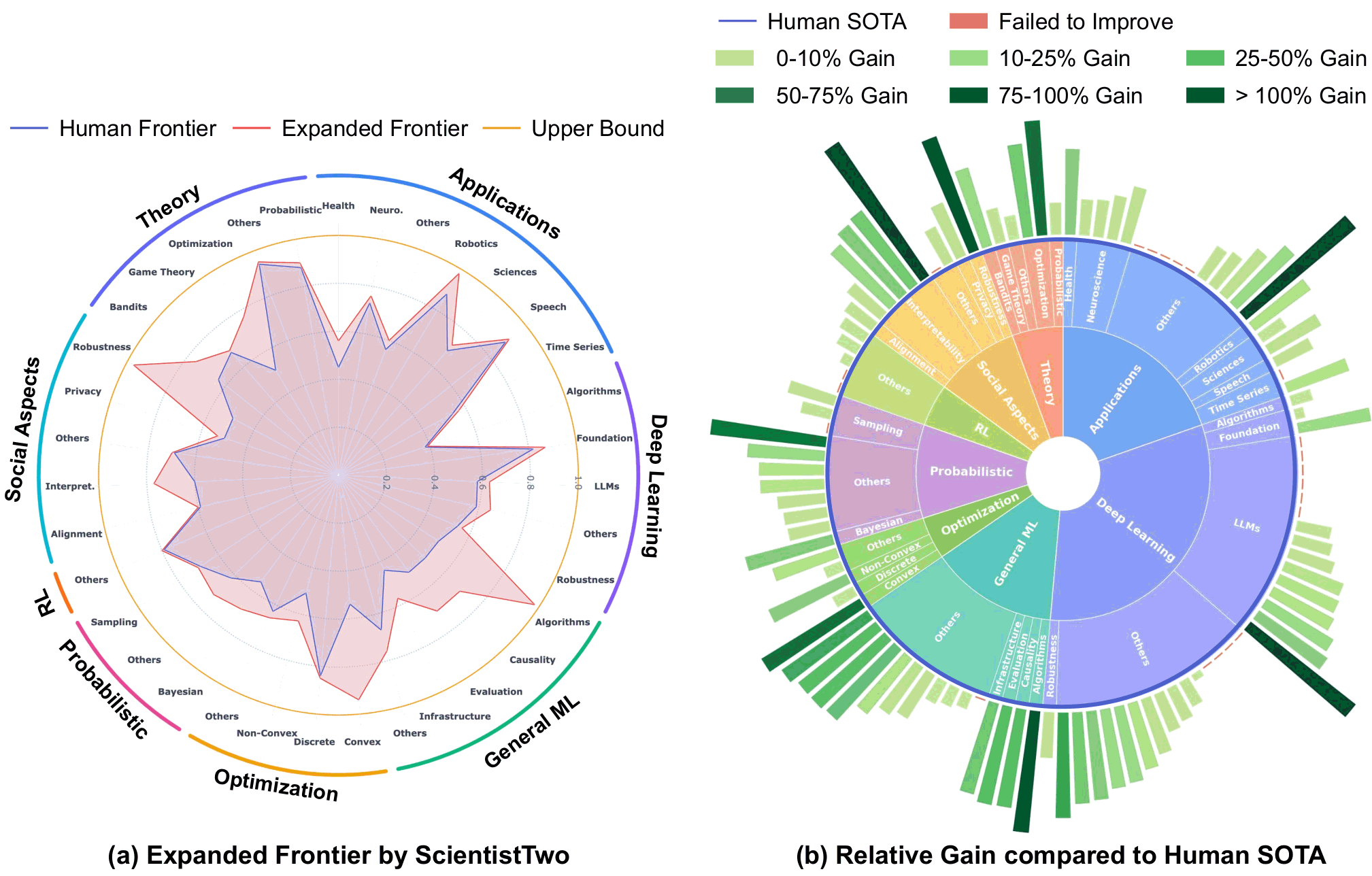
Left: radar chart of the human frontier versus the frontier expanded by ScientistTwo across all sub-domains. Right: sunburst chart of the relative gain over human SOTA per sub-domain.
(a) Expanded frontier. The red contour marks the performance frontier reached by ScientistTwo, plotted against the human state-of-the-art (blue) and the task upper bound (orange) for every sub-domain. (b) Relative gain over human SOTA. Each outward bar is one generated paper, shaded by the size of its improvement; bars extending past the blue ring beat the human baseline, and only the salmon-colored slices fall short.

How It Works

A Closed Loop from Idea to Accepted Paper

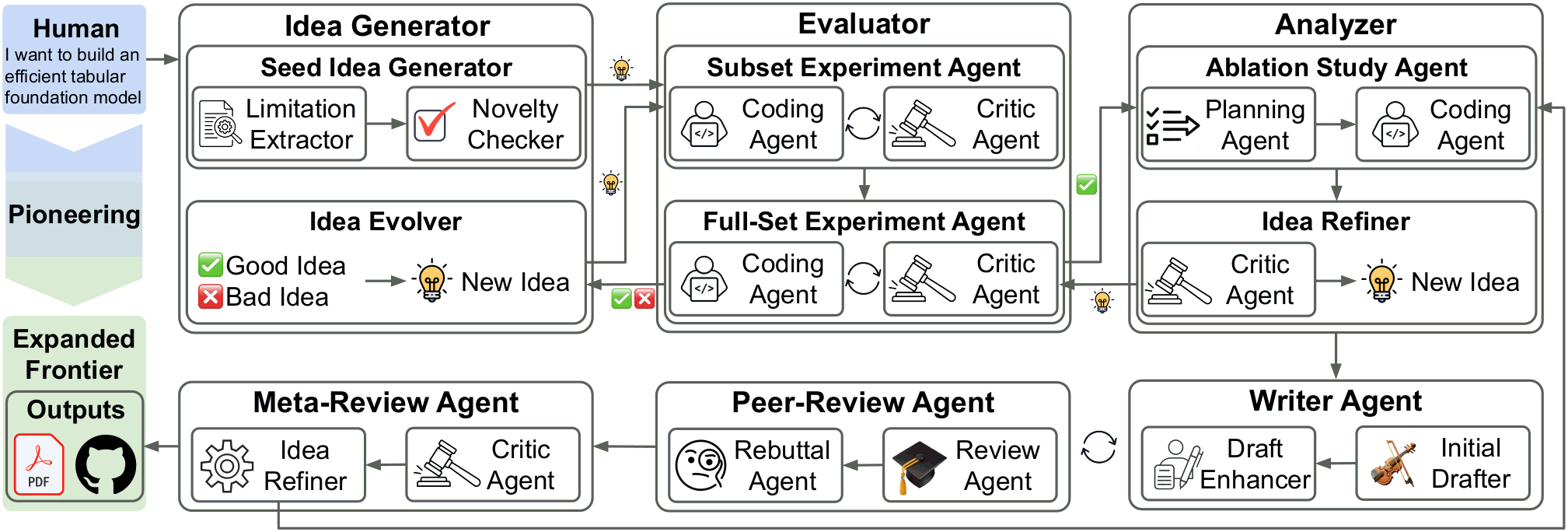
ScientistTwo runs the full research cycle on its own: it generates and evolves ideas, validates them experimentally, isolates what actually works, writes the manuscript, and then subjects that manuscript to its own peer review—looping back until the work clears a publication bar.

ScientistTwo pipeline: Idea Generator, Evaluator, and Analyzer in the top row, feeding a Writer Agent, Peer-Review Agent, and Meta-Review Agent in the bottom row, with feedback loops back to the Idea Generator.
System overview. Six agent groups form one closed loop—the Idea Generator proposes and evolves hypotheses, the Evaluator screens them on benchmark subsets before full-scale runs, the Analyzer ablates and refines the surviving idea, and the Writer, Peer-Review, and Meta-Review agents iterate on the manuscript until acceptance criteria are met.
Holistic Benchmarking, Efficient Screening

Ideas are judged on comprehensive multi-dataset benchmarks rather than a single metric, avoiding overfitting. A subset-first strategy filters candidates on representative benchmark slices before committing compute to full-scale experiments.

Ablation-Driven Hypothesis Refinement

Mirroring the empirical rigor of expert researchers, ScientistTwo designs and runs its own ablation studies to isolate each component's contribution, then prunes the ineffective ones and sharpens its core hypothesis.

Peer-Review & Rebuttal Loops

A Peer-Review Agent critiques every draft, and a Rebuttal Agent answers by conceiving, coding, and running new targeted experiments—not just editing text. A Meta-Review Agent supervises the cycle, re-triggering refinement until rigorous acceptance criteria are satisfied.

Main Results

Reviewed at the Bar of Top-Tier Venues

We score every paper with two automated reviewers—ScholarPeer and the Stanford Agentic Reviewer—and compare against both prior research agents and papers actually accepted at NeurIPS 2025, ICLR 2026, and ICML 2026, whose problem specifications and codebases serve as the benchmark tasks. ScientistTwo reaches a 91.9% acceptance rate under ScholarPeer, and is the only agent to clear the Stanford Agentic Reviewer at all—72.1% of its papers meet that bar, while every baseline scores 0%.

Framework # Papers ScholarPeer Stanford Agentic Reviewer
Avg. Rating Accept Rate Avg. Rating Accept Rate
Human-authored
ICLR 2026 Accepted 5 6.8 ±1.6 60.0% 5.2 ±0.7 60.0%
NeurIPS 2025 Accepted 38 6.2 ±1.9 65.8% 5.5 ±0.7 76.3%
ICML 2026 Spotlight 64 6.9 ±1.5 79.7% 6.1 ±0.5 96.9%
AI-generated
AI-Researcher 7 1.0 ±0.0 0.0% 2.4 ±0.6 0.0%
CycleResearcher 6 1.0 ±0.0 0.0% 2.8 ±1.0 0.0%
AI Scientist-v2 3 2.0 ±1.0 0.0% 2.5 ±0.2 0.0%
AutoResearchClaw 4 2.5 ±1.0 0.0% 3.7 ±0.5 0.0%
Zochi 2 3.0 ±0.0 0.0% 2.9 ±0.6 0.0%
DeepScientist 3 3.0 ±0.0 0.0% 4.1 ±0.6 0.0%
ScientistOne 21 3.8 ±1.2 14.3% 4.1 ±0.7 0.0%
ScientistTwo (Ours) 86 7.5 ±1.3 91.9% 5.7 ±0.6 72.1%

Average review ratings (1–10 scale) with standard deviations, and acceptance rates. “# Papers” is the number of papers aggregated per row.

Papers generated by ScientistTwo surpass the average scores of accepted ICLR 2026 and NeurIPS 2025 papers under both reviewers. Spotlight-level quality remains out of reach, but ScientistTwo operates as an expert-level research agent producing manuscripts that meet the acceptance threshold of top-tier AI venues.

Integrity

Every Claim Backed by Its Artifacts

Strong scores mean nothing if the underlying results are not real. The CoE Integrity Audit is a post-hoc framework that checks whether a paper's claims are actually supported by its code, empirical outputs, and bibliography, via four checks: score verification (re-running the repository reproduces every reported number), specification compliance (no rule-breaking or reward hacking), reference verification (no hallucinated citations), and method–code alignment (the manuscript faithfully describes the implementation).

Three dedicated refinement agents enforce these properties: a validation filter discards rule-violating solutions right after experimentation, a search-augmented LLM grounds and corrects the bibliography, and a code audit reconciles the method section against the repository. Reproducibility is handled up front, by prompting the Coding Agent to emit self-contained, re-runnable scripts.

Framework Refinement Agent Integrity Audit
Spec. Compl. Ref. Verif. Method–Code Score Verif. ↑ Spec. Violat. ↓ Ref. Verif. ↓ Method–Code ↑
ScientistTwo (variant) 50 / 50 1 / 50 19 / 1840 39 / 50
ScientistTwo (variant) 49 / 49 0 / 49 19 / 1817 38 / 49
ScientistTwo (variant) 49 / 49 0 / 49 0 / 1814 38 / 49
ScientistTwo (Ours) 49 / 49 0 / 49 0 / 1814 49 / 49

Paper and code integrity, evaluated following the CoE Integrity Audit of ScientistOne. The left block marks which refinement agents are enabled; the right block reports audit outcomes. Score verification needs no refinement agent—reproducibility is enforced during experimentation.

The full system passes all four audits: every reported score reproduces, no specification is violated, not one of 1,814 references is hallucinated, and all 49 papers match their code. Removing the refinement agents produces sporadic failures across each check.

BibTeX

@article{nam2026scientisttwo,
  title     = {ScientistTwo: Pioneering the Human Knowledge Frontier with Autonomous AI},
  author    = {Nam, Jaehyun and Yoon, Jinsung and Pan, Yanzhou and Wang, Yubo and Meng, Rui and Ranganathan, Parthasarathy and Pfister, Tomas},
  journal   = {arXiv preprint arXiv:2609.19644},
  year      = {2026}
}